

Special Undercut Ejection Mechanism
There are many common methods to release undercuts in injection molds, such as side actions (sliders), angled lifters (cams), spring-loaded slides, etc. Some designs even feature sophisticated combinations: large and small sliders working together, sliders combined with angled lifters, sliders paired with straight ejectors, or even “dual-action” mechanisms where an angled lifter embraces a straight ejector—working in perfect harmony.Below, we’ll focus on a novel side-action mechanism that integrates mold opening, ejection, and undercut release simultaneously—a “lift-while-eject” system.
1. First, Let’s Examine the Part Geometry
The part in question is an automotive plastic water tank made of PP material.
A specific area of the part—located above the parting line—features a circumferential external thread around a nozzle, along with an internal hole. This region presents a significant molding challenge: it contains undercuts that cannot be released in any conventional direction (A, B, C, or D).
Attempting ejection in Direction D is blocked by the undercut surface in that direction.
Attempting ejection in Direction B is obstructed by the undercut edge in that direction.
(See Figure 1 below.)
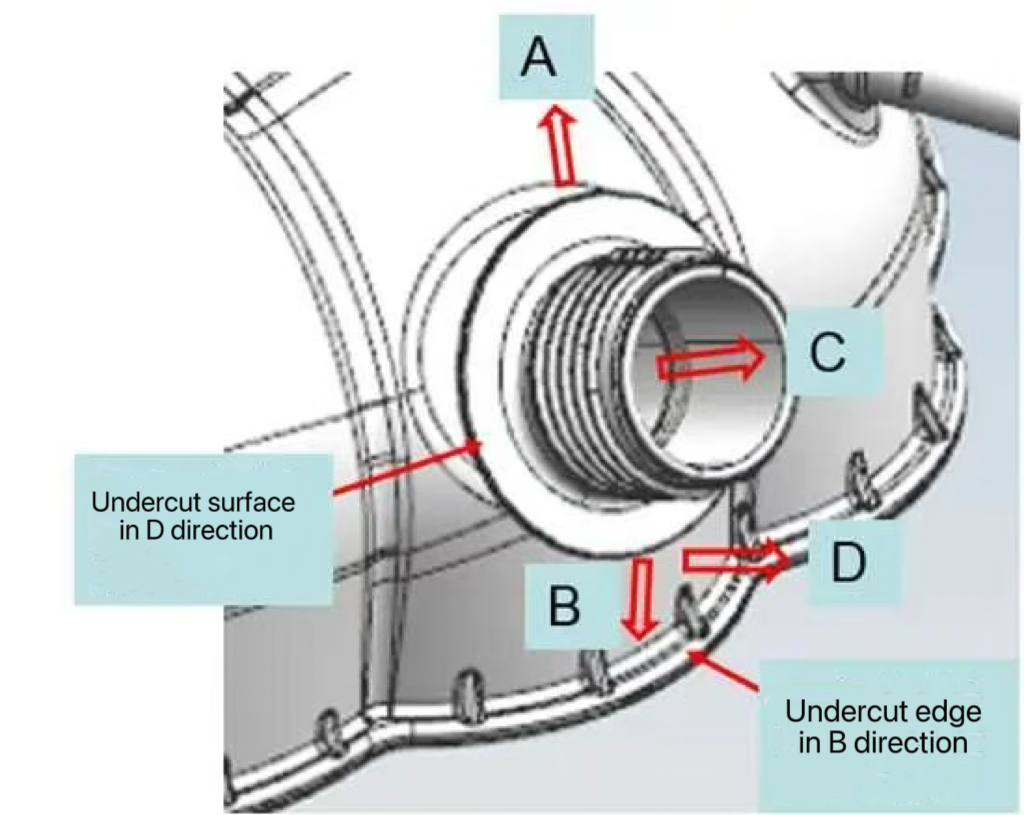
Figure 1: Part Geometry
2. Given the part’s geometry, conventional ejection methods—such as standard sliders or angled lifters—are not practical. Therefore, an unconventional and innovative mechanism had to be developed. After extensive evaluation and multiple rounds of refinement, we ultimately decided to adopt the following “simultaneous lifting-and-ejecting” mechanism (see Figure 2). The sequence of operation is as follows:
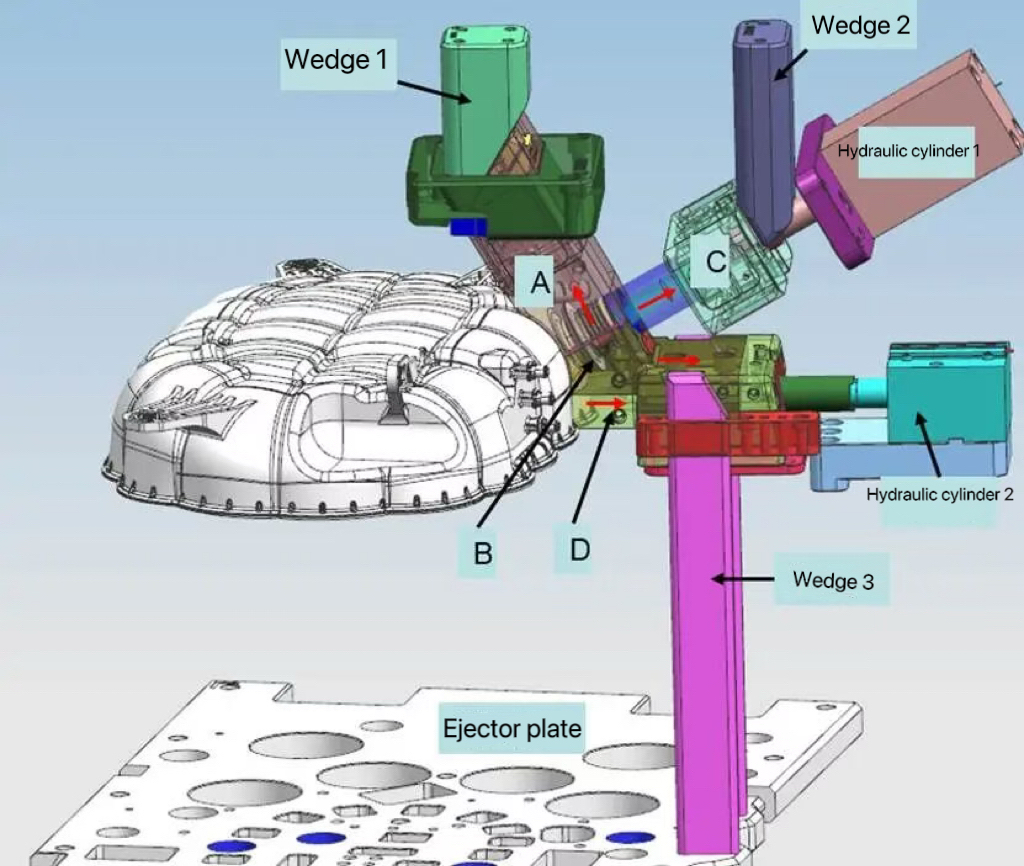
Figure 2: Mold Ejection Structure Diagram
1. Utilize the injection machine's mold-opening power to drive Slide Base 1, which moves Slider A for core pulling, while simultaneously opening Slide Base 2.
2. Cylinder 1 drives Slider C for internal hole core pulling, using the injection machine’s mold-opening action to complete the core pulling of Slider A.
3. Cylinder 2 drives Slider D for core pulling, reserving space for Slide Base 3. During the product ejection process, Slide Base 3 moves Slider B to release the undercut, allowing the product to be smoothly ejected. Slider B and Slider D operate both independently and in conjunction, ultimately merging seamlessly to achieve a smooth ejection.The most brilliant aspect of this mechanism is step 3. It ingeniously uses the sequence of time, combined with the concept of spatial transformation, to perfectly synchronize the ejection and undercut release. This demonstrates that accommodation and inclusiveness are not only reflected in human relationships but can also be applied effectively in practical production.
3. Mold Closing Process
1. The Ejector Plate must first return to its original position.
2. Cylinder 1 and Cylinder 2 drive their respective sliders back to their initial positions.
3. All plates close normally as part of the mold closing sequence.
In summary, there is an order to both opening and closing the mold; orderly processes lead to successful outcomes.